Motivation
I am an atmospheric scientist interested in understanding weather and climate over land. I primarily use global gridded data from reanalysis and remote sensing datasets to identify ways in which land surfaces processes may influence local, regional, and global weather and climate. I then reference and also run my own experiments in climate models of varying complexities to understand and explain those results. My work is at the intersection of the atmospheric and hydrological sciences, and some examples of the tools I commonly use in my research are:
- Experiments in the Community Earth System Model (CESM2)
- Satellite Observations from the Soil Moisture Active Passive (SMAP) Instrument
- Output from Models Participating in the Couple Model Intercomparison Project (CMIP)
- Results from the Global Land Atmosphere Coupling Experiments (GLACE)
- EOF (Principal Component) Analysis
- Linear Inverse Modeling
Projects
Soil Moisture Teleconnections in the Western United States
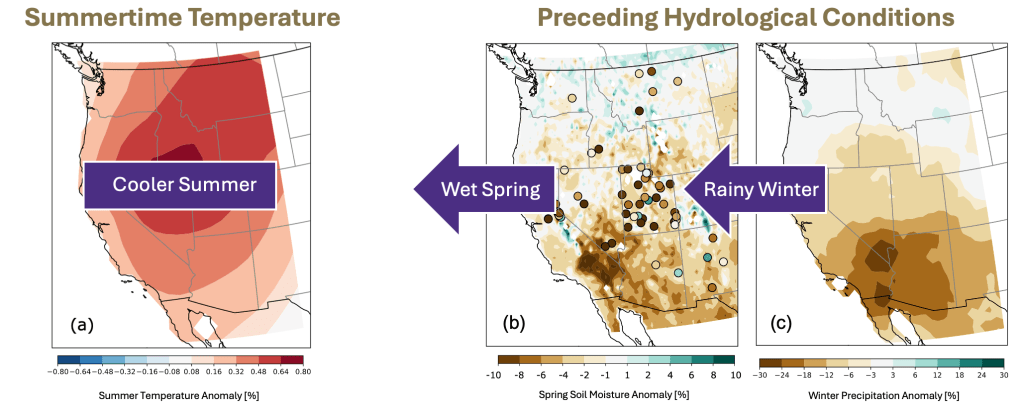
Interannual variability in summertime temperatures has a large impact on drought, wildfire, and extreme heat. We are studying how preceding hydrological conditions may drive higher-than-average summer temperatures in certain regions. These findings may have important implications for how memory in the water cycle can lead to greater predictability in the climate system on seasonal time scales.
Papers
- Vargas Zeppetello, L. R., Zhang, L. N., Battisti, D. S., and Lague, M. M. (2024). How Much Does Land-Atmosphere Coupling Influence Seasonal Temperature Variability in the Western United States? Journal of Climate, 37(13), 3457-3478. https://doi.org/10.1175/JCLI-D-23-0716.1
- Zhang, L.N., Battisti, D.S., Vargas Zeppetello, L.R. and Laguë, M. M. Springtime Soil Moisture Teleconnections Drive Summertime Warming in the Western United States. Journal of Climate (in revision): read preprint
Soil Moisture-Convection Interactions
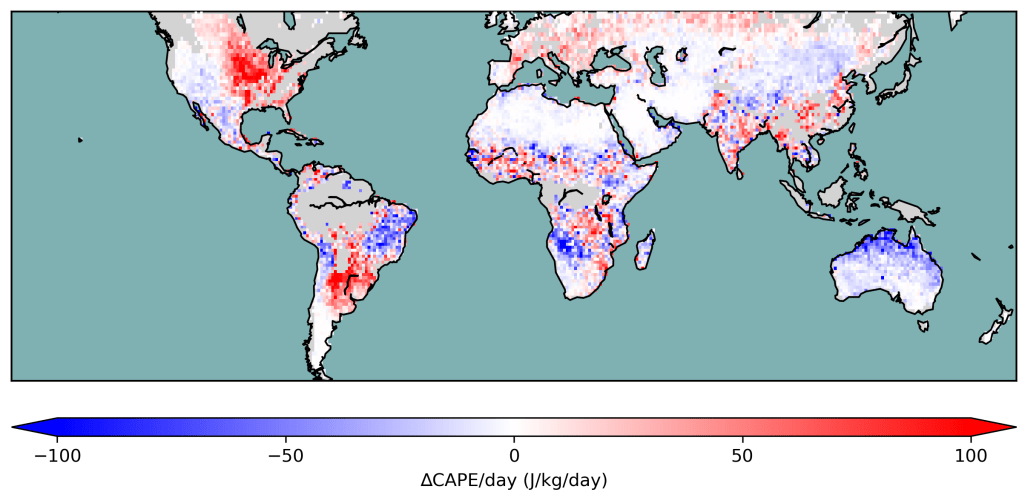
Increases in convective available potential energy (CAPE) at the base of the atmospheric column can be driven by surface turbulent fluxes. We analyze the influence of soil moisture on convective development by tracking CAPE evolution during interstorm periods.
From remote sensing data, we found clear spatial and temporal trends that link summertime convective development to soil moisture content and evaporation (Zhang et al., 2023). Using these observational results as a benchmark, I am currently exploring soil-moisture convection relationships in (1) CMIP models and (2) ground-based observations.
Papers
- Zhang, L. N., Short Gianotti, D. J., & Entekhabi, D. (2023). Land Surface Influence on Convective Available Potential Energy (CAPE) Change during Interstorms. Journal of Hydrometeorology, 24(8), 1365-1376. https://doi.org/10.1175/JHM-D-22-0191.1
Other Activities
Past & Side Projects
Antarctic Ozone: In the 1980s, measurements at the British Antarctic Survey station in Halley, Antarctica led to the discovery of the ozone hole. The Halley total ozone record continues to be uniquely valuable for studies of long-term changes in Antarctic ozone. Environmental conditions in 2017 forced a temporary cessation of operations, leading to a gap in the historic record. In Zhang et al. (2021), we developed and tested a method for filling in the Halley record using satellite data and find evidence to further support ozone recovery.
- Zhang, L. N., Solomon, S., Stone, K. A., Shanklin, J. D. Eveson, J. D., Colwell, S., Burrows, J. P., Weber, M., Levelt, P. F., Kramarova, N. A., Haffner, D. P., On the use of satellite observations to fill gaps in the Halley station total ozone record, Atmospheric Chemistry and Physics, 21 (12) 9829-9838, 2021. doi: 10.5194/acp-21-9829-2021
Observed Trends in Coastal CO2 Fluxes: An anthropogenically driven increase in atmospheric CO2 concentrations is known to drive an increase in the globally integrated ocean carbon sink. However, there is significant regional and seasonal variability, and significant changes in seasonal cycle amplitudes have been predicted. Three decades of sea surface observations collected from the southeast Florida Current and shelf waters reveal behavior over seasonal and interannual timescales for a region important to global carbon storage and transport. We find that uptake in this region has not changed over the last three decades after accounting for sampling bias, demonstrating that seasonally biased data are thus not only a problem for polar regions but can also affect flux calculations in sub-tropical regions.
- Zhang, L. N. and Woosley, R. J., Seasonal trends in the Southeast Florida current and shelf CO2 fluxes, Continental Shelf Research, 229, 104566, 2021. doi:10.1016/j.csr.2021.104566.
 Lily N. Zhang