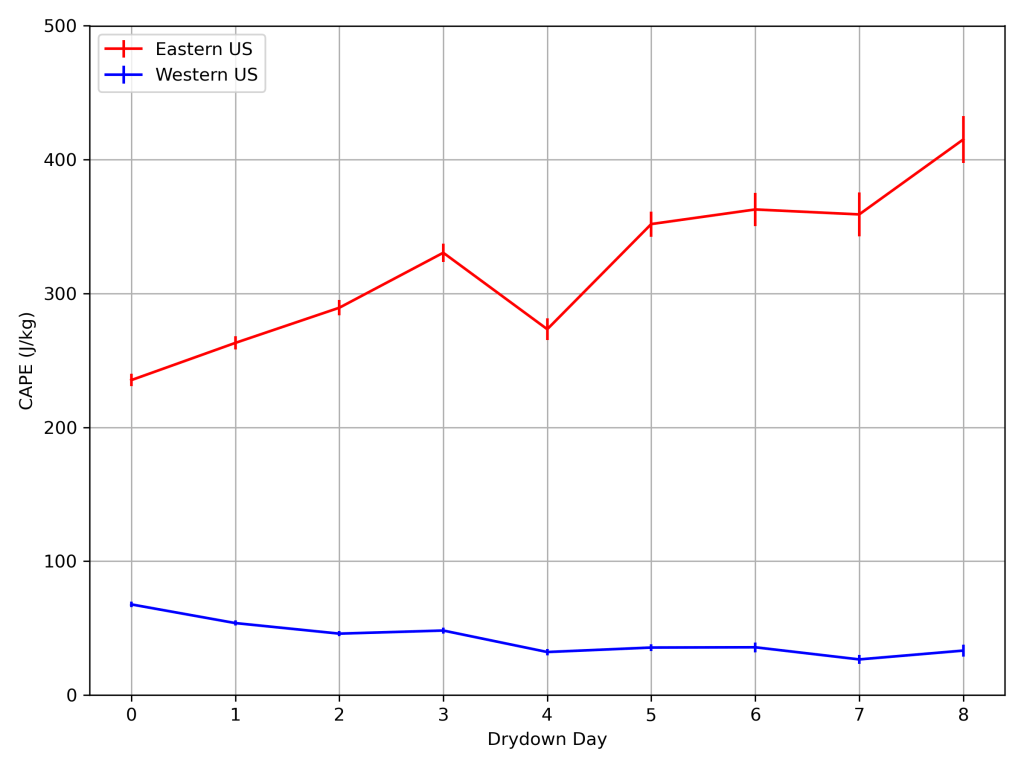
Using two global satellite datasets (SMAP and AIRS), we analyze the impact of surface energy balance partitioning on convective development by tracking CAPE over soil moisture drydowns (interstorms) during the summer, when land–atmosphere coupling is strongest. Our results show that the sign and magnitude of CAPE development during summertime drydowns depends on regional hydroclimate and initial soil moisture content. Overall, we find clear spatial and temporal trends that link summertime convective development to soil moisture content and evaporation, providing a basis for understanding the soil moisture–precipitation relationship, as well as land–atmosphere interaction as a whole.
Read Zhang et al. (2023) at https://doi.org/10.1175/JHM-D-22-0191.1
 Lily N. Zhang
Leave a comment